A guide to lineageThere is more depth in yoga than you have been able to reach.Updated September 2026

Lineage · Krishnamacharya, through Manju Jois and Srivatsa RamaswamiAshtanga and Vinyasa Krama
in Salt Lake City.

You have practiced long enough to notice that most classes cannot tell you where the practice came from. Two of the methods that shaped modern yoga both trace to one teacher, Sri T. Krishnamacharya, and both are taught here in Salt Lake City by two teachers who studied with Manju Jois and with Srivatsa Ramaswami.

This guide explains what each method is, how they relate, and how you can study them with YogaSoul.

By Rachel Cieslewicz, C-IAYTAshtanga via Manju JoisVinyasa Krama via Srivatsa Ramaswami
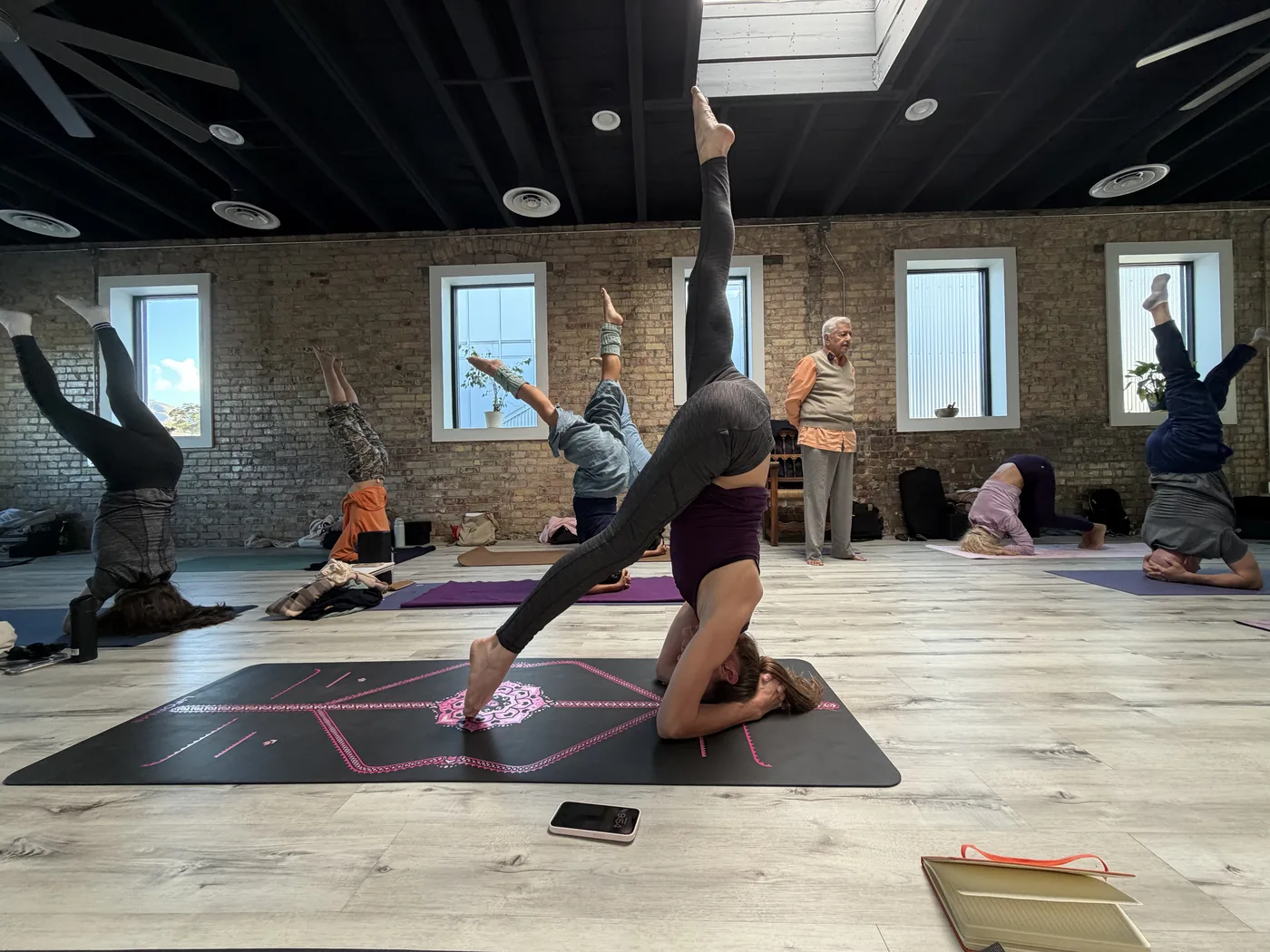
The room in shoulder stand while Srivatsa Ramaswami watches, Salt Lake City 2025
Vinyasa Krama with Srivatsa Ramaswami · Salt Lake City, 2025

01 · Ashtanga

A fixed series,
learned one posture at a time.

Ashtanga, as taught by K. Pattabhi Jois in Mysore, India, is a set sequence of postures practiced in the same order each time, linked by breath and movement.

Pattabhi Jois studied with Krishnamacharya from 1927, and in 1948 he established the Ashtanga Yoga Research Institute in Mysore. The method he taught is organized into series: the primary series first, then the second series, and further series beyond.

Because the sequence does not change, the practice becomes a mirror. Anything that shifts from one morning to the next is you, not the class.

Three places of attention

Ashtanga teachers describe the practice through tristhana, three things you attend to at once: the breath, the posture, and drishti, the point where the eyes rest. Each movement into and out of a posture is matched to a breath. That linking of breath and movement is vinyasa.

Mysore style

Ashtanga is traditionally taught in a Mysore-style room. Everyone practices the series they have been given, at their own breath’s pace, while the teacher moves through the room and works with each person individually. New postures are added as a student is ready for them. It looks like a class. It is closer to a room full of private lessons.

Led class

The other way Ashtanga is taught is the led class. The teacher counts aloud, traditionally in Sanskrit, calling each movement and the breath that goes with it, and the whole room moves through the series together at one pace. Where Mysore style lets each person keep their own rhythm, a led class holds everyone to the traditional count, which shows where the breath has drifted and keeps the sequence precise. Many Ashtanga rooms pair a weekly led class with Mysore-style practice on the other days.

02 · Vinyasa Krama

The art of sequencing,
shaped to the person.

Vinyasa Krama is the way Srivatsa Ramaswami presents what he learned from Krishnamacharya, his teacher for more than thirty years beginning in 1955.

The name is often translated as the art of sequencing. Taken apart, vi means variation, nyasa means placing within set parameters, and krama means sequence, or stages. Postures are arranged so that each movement prepares the next, in families of sequences built around a starting position: standing, seated, lying on the back, lying on the front, inverted, and seated for breathing and meditation.

Ramaswami gathered these sequences, hundreds of postures and variations, in The Complete Book of Vinyasa Yoga.

Breath first

The breath is slow and long, and it sets the pace of the movement rather than the other way round. Ramaswami’s teaching is plain about this: if the breath does not slow over the course of the practice, it is exercise, not yoga.

Adapted, not fixed

Vinyasa Krama is not one routine. A teacher draws on the sequences to build a practice for a particular person, and the balance changes over a lifetime, with more posture work when you are young and more breathing and meditation later. Ramaswami’s Yoga for the Three Stages of Life is about exactly that.

In the autumn of 2025 he taught a 100-hour Vinyasa Krama intensive at YogaSoul, from September 22 to October 7.

03 · How they relate

One teacher,
two emphases.

Ashtanga and Vinyasa Krama are not rival styles. Both come from Krishnamacharya’s teaching of linking breath to movement in sequence. Ashtanga fixed a set of those sequences into series you learn in order. Vinyasa Krama keeps the wider library and chooses from it.

AshtangaVinyasa Krama
Came throughK. Pattabhi Jois, in MysoreSrivatsa Ramaswami, in Chennai (then Madras)
The sequenceFixed series, practiced in the same order: primary, second, and beyondA large library of sequences, chosen and combined for the person and the day
The breathOne breath per movement, steady and even, with tristhana: breath, posture, drishtiSlow, long breathing that paces the movement, with prāṇāyāma given a large share of practice
How it is taughtTraditionally Mysore style: self-practice in a room, with individual adjustmentTaught as a way of building sequences, adapted to the student’s age, body and need
What it buildsDiscipline, heat, and a practice you can carry anywhere because you know it by heartAn understanding of how to sequence, so you can build a practice for yourself or a student
Shared rootSri T. Krishnamacharya (1888 to 1989), who taught both Pattabhi Jois and Srivatsa Ramaswami
A simplified comparison. Both traditions include far more than posture practice.

04 · The lineage

Who taught
whom.

A tradition that can name its teachers is a lineage. Here is ours, stated exactly.

Sri T. Krishnamacharya1888 to 1989

Ashtanga

  1. K. Pattabhi JoisStudied with Krishnamacharya from 1927
  2. Manju JoisHis eldest son, teaching since his teens

Vinyasa Krama

  1. Srivatsa RamaswamiStudied with Krishnamacharya for more than thirty years
Rachel Cieslewicz & Eric MartinBoth authorized to teach Ashtanga primary and second series, through Manju Jois. Both studied Vinyasa Krama with Srivatsa Ramaswami and have his permission to teach it.
Krishnamacharya also taught B.K.S. Iyengar, Indra Devi and his son T.K.V. Desikachar, among others.

Manju Jois

Manju Jois is the eldest son of K. Pattabhi Jois. He learned from his father as a boy in Mysore, began teaching alongside him, and came to the United States with him in 1975, where he has taught ever since. Rachel and Eric are both authorized by him to teach Ashtanga primary and second series.

Srivatsa Ramaswami

Srivatsa Ramaswami began studying with Krishnamacharya in 1955 and continued for more than thirty years. He is the author of The Complete Book of Vinyasa Yoga, Yoga for the Three Stages of Life, and a translation of the Sāṃkhya Kārikā. Rachel and Eric both studied Vinyasa Krama with him and have his permission to teach it, and YogaSoul hosted his intensive in 2025.

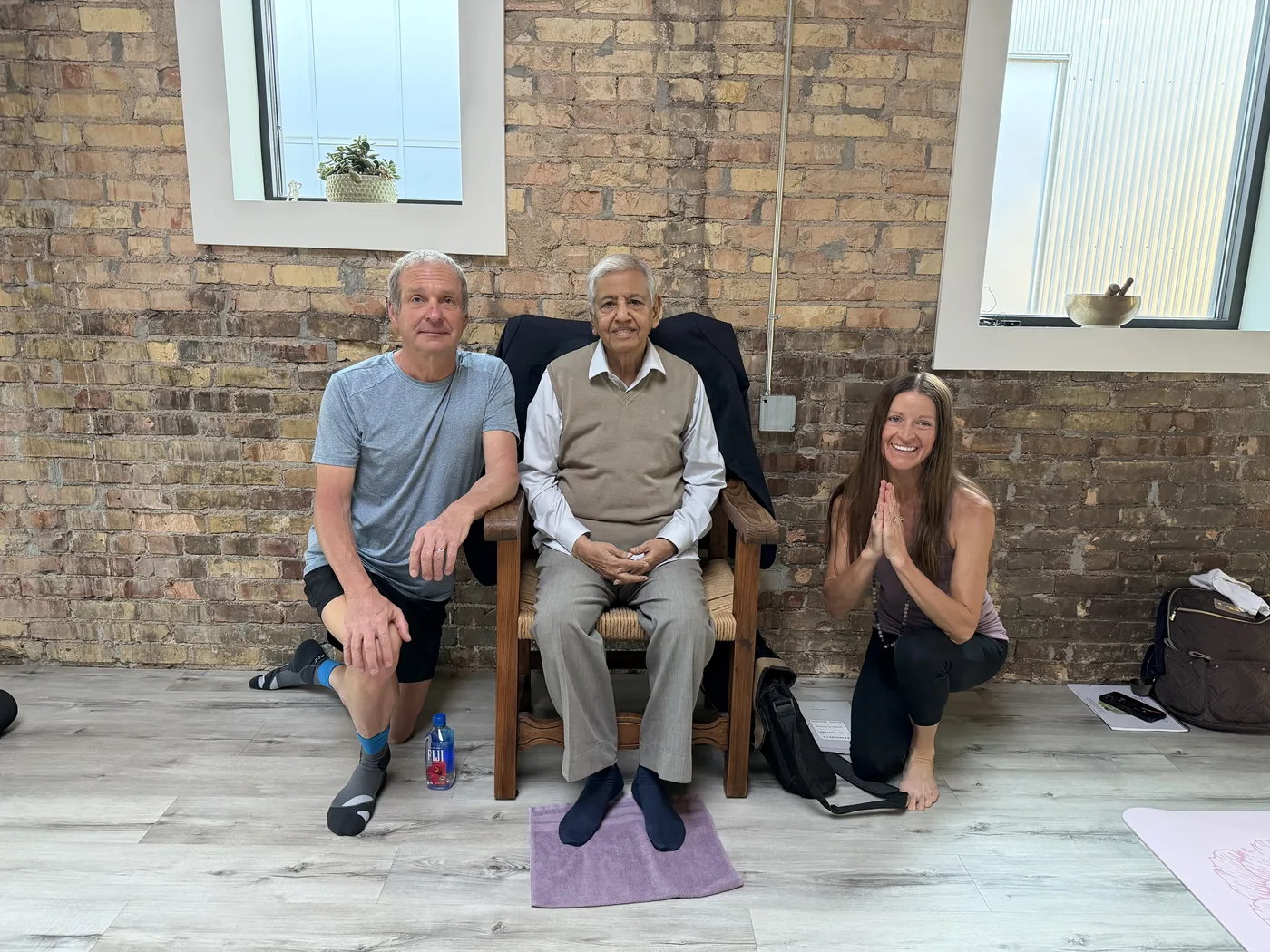
Eric Martin, Srivatsa Ramaswami and Rachel Cieslewicz after the 2025 Vinyasa Krama intensive in Salt Lake City

05 · Lineage in our trainings

What was handed down
is what we teach.

YogaSoul’s teacher training began in 2013, and Rachel Cieslewicz designed the curriculum and leads the training, with guest teachers adding to it.

In the 200-Hour Training, the posture curriculum includes the Ashtanga primary series alongside vinyasa flow, restorative and yin, and therapeutic postures. You also study sequencing, prāṇāyāma, philosophy and ethics, and history and lineage. The reading list includes Ramaswami’s Sāṃkhya Kārikā and T.K.V. Desikachar’s The Heart of Yoga.

The 300-Hour Advanced Training goes further into advanced vinyasa, sacred geometry in sequencing, advanced prāṇāyāma and meditation, the basics of Sanskrit, and history and lineage.

Both trainings are in person in Salt Lake City and begin February 5, 2027. Both certify through the World Yoga Federation and are not registered with Yoga Alliance. Our guide to the World Yoga Federation and Yoga Alliance explains the difference.

06 · Practice with YogaSoul

Three ways in,
depending on where you are.

You do not need to commit to a training to study with teachers in this lineage. Start where it makes sense for you.

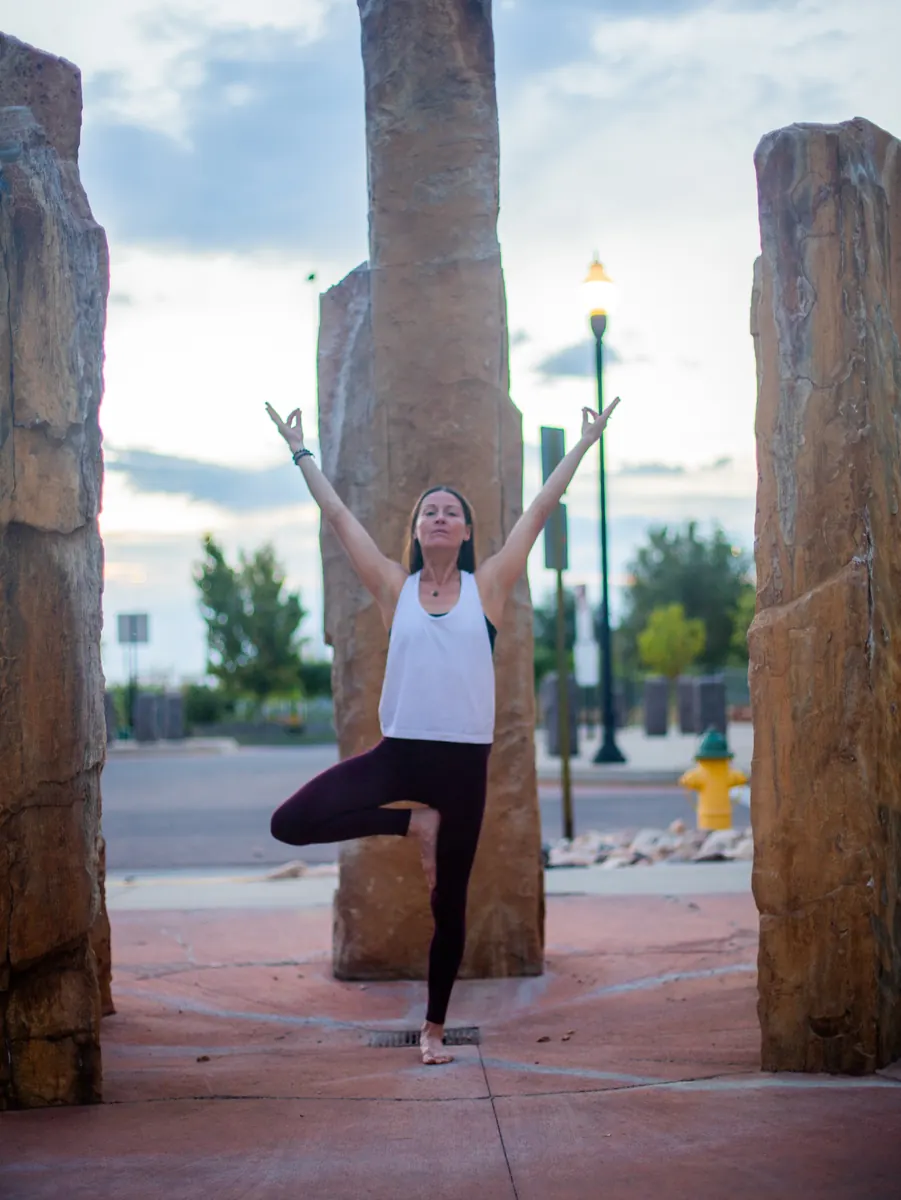
Rachel Cieslewicz teaching at her shala

Classes at the shala

Rachel teaches small-group classes at her shala in East Millcreek, twice a week on weekday mornings when she is in town. A handful of students, no front desk. Drop-ins are $25, and the schedule and address come by email. See shala passes.

Teacher training

The 200-Hour ($3,300) is where most people begin. The 300-Hour Advanced ($4,700) is for teachers who already hold a 200-hour from any school. Both start February 5, 2027.

The Ramaswami archive

Our record of the 2025 Vinyasa Krama intensive covers what he taught, the texts studied, and his books. If you want to hear first about future visiting teachers, write to Rachel.

Still deciding

Questions people ask first.

Is there Ashtanga yoga teacher training in Salt Lake City?

YogaSoul’s 200-Hour Training in Salt Lake City includes the Ashtanga primary series in its posture curriculum, taught by Rachel Cieslewicz and Eric Martin, who are both authorized to teach Ashtanga primary and second series through Manju Jois. It is a broad teacher training rooted in this lineage, not an Ashtanga-only course.

Will a YogaSoul training authorize me to teach Ashtanga?

No. Our trainings lead to a World Yoga Federation certification. Authorization in Ashtanga is given by a teacher in that lineage to a student they have worked with, usually over years of practice. It is separate from any teacher training certificate.

What is Vinyasa Krama?

The method Srivatsa Ramaswami learned from Krishnamacharya over more than thirty years: postures arranged in sequences so each movement prepares the next, with slow breathing setting the pace, and the practice adapted to the person rather than fixed.

Do I need to practice Ashtanga already?

No. People come to the 200-Hour from many kinds of practice. What helps most is a regular practice of your own and curiosity about where it came from. If you are unsure, write to Rachel and tell her what you practice now.

Who authorized your teachers?

Rachel and Eric are both authorized to teach Ashtanga primary and second series, through Manju Jois, the son of K. Pattabhi Jois. Both studied Vinyasa Krama with Srivatsa Ramaswami, a student of Krishnamacharya for more than thirty years, and have his permission to teach it.

Is the training registered with Yoga Alliance?

No. Both trainings are certified by the World Yoga Federation, and the certificate is included in tuition. If a studio you hope to teach at asks for Yoga Alliance by name, write to Rachel before you enroll.

A YogaSoul teacher training weekend at the shala in Salt Lake City

Learn it from people
who can name their teachers.

The 200-Hour and 300-Hour trainings begin February 5, 2027, in person in Salt Lake City, twelve people at most. If you have a question about the lineage, or about which training fits, write to Rachel. She reads every email herself.

Stay Connected

Keep the practice moving,
even between visits.

Retreat announcements, teacher training updates, workshop invites, and practice inspiration, straight to your inbox. No noise. Just the good stuff.

The next retreat could be one you experience, or one you hear about after it fills.

Rachel and Eric write it. Not a marketing team, not a scheduler. Rachel has been formally teaching and studying for 28+ years and training teachers for 25+, and most of what goes out is whatever she is actually working through that month, plus first word on retreats and cohort openings before they are posted anywhere.

28+ Years Formal Teaching and Studying 300+ Teachers Trained WYF Certified School

One email at a time, from an address you can reply to.

This site is protected by reCAPTCHA and the Google Privacy Policy and Terms of Service apply.