A walking guideRest is not something you book. It is something you practice.Updated September 2026

A walking guide · Meteora, GreeceHiking the Meteora trails,
on the old monastery paths.

Most visitors see Meteora from a tour bus window and a car park. The better way is on foot, on the stone steps and woodland footpaths that connect the villages at the base of the rocks to the monasteries on top.

This guide covers the landscape our Meteora retreat walks: Kastraki and Kalambaka, the paths up to the monasteries, what the terrain is like, the rules at the monastery door, the weather in late May, and what to carry.

By Rachel Cieslewicz & Eric MartinWe walked these trails firstUpdated September 2026
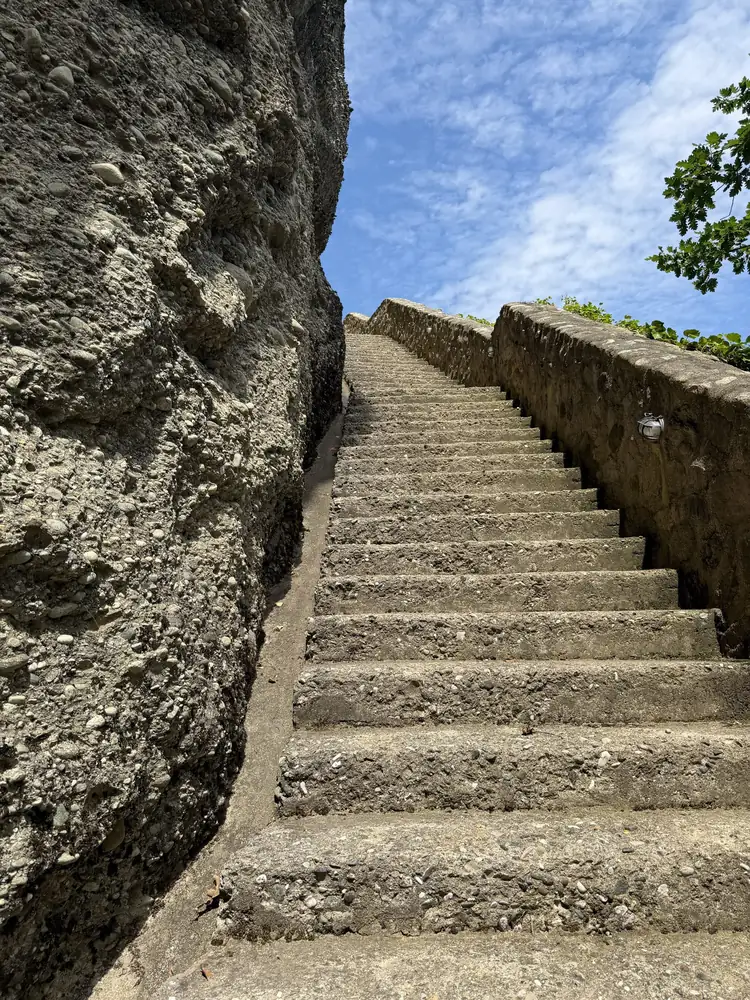
Stone steps climbing alongside a rock pillar toward a monastery in Meteora
Stone steps toward a monastery · Meteora

01 · The landscape

Two villages
at the foot of the rocks.

The word Meteora means suspended in the air. Pillars of sandstone and conglomerate rise straight out of the plain of Thessaly in central Greece, with monasteries built on their summits. The site has been on UNESCO’s World Heritage List since 1988.

Kalambaka is the town beneath the southern rocks, with the train station, shops and the start of the path to the Holy Trinity monastery. Kastraki is the smaller village just to the north, tucked right against the pillars, a walk of roughly an hour from Kalambaka on foot. Several of the monastery footpaths begin at its edge.

Between and above the two, the old paths climb through oak woods, past hermit caves and small chapels, to the monasteries. Before roads reached the tops of the rocks, these paths, along with ladders and rope-drawn nets, were how people came and went.

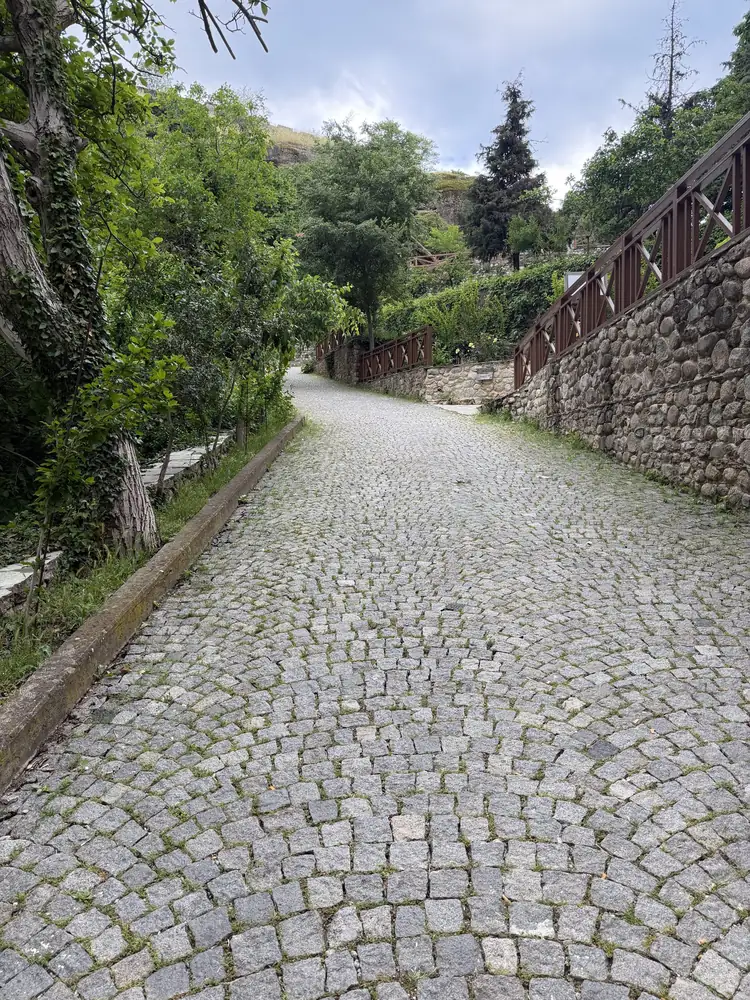
A cobblestone lane winding up through Kastraki village

02 · The trails

The monastery footpaths,
at a glance.

A selection of the paths most walkers use. Distances and times are one way, as published by the local geopark, the Meteora tourist information office and Greek hiking guides, and they are walking times without stops. Your own pace, and time spent at each monastery, will add to them.

Where it goesDistance and timeWhat it is like
Kastraki to Great Meteoron and VarlaamFrom Kastraki square, by the Museum of Geological Formations, up past the monastery of Agios Nikolaos Anapafsas and Great Meteoron to VarlaamAbout 2.1 km (1.3 mi), around 45 minutesModerate. A steady climb among the rocks, with rockfall from the cliffs visible on the lower slopes
Kalambaka to Holy TrinityFrom the town hall square, up through the old quarter of Kalambaka to the Holy Trinity monasteryAbout 1.1 km (0.7 mi) and 200 m (about 650 ft) of climbing, around 40 minutesPaved for most of the way, with a short unpaved stretch near the top. Marked with yellow squares
Kastraki to Holy Spirit and VarlaamFrom the eastern edge of Kastraki, up the rock of the Holy Spirit to the monastery junctions below Varlaam and Great MeteoronAbout 2.4 km (1.5 mi), around 1 hour 10 minutesStone paths through dense vegetation between the rocks, with a few exposed points that need care
Kalambaka to KastrakiAlong the base of the rocks between the town and the villageAbout 2.1 km (1.3 mi), around 1 hourA mix of quiet road, dirt track and shaded rocky trail
Great Meteoron circular walkA loop through the woods from near Great MeteoronAbout 5.9 km (3.7 mi), around 2 hours 15 minutesForest walking and rocky high points, with a short detour to a small chapel if you want it
Panagia Kanaliotissa loopA circular walk through oak forest to a stone chapel, starting near the Varlaam roadAbout 3.1 km (1.9 mi), around 1 hour 10 minutesDense forest, an uphill section, and a return along a stream
Sources: Meteora-Pyli Geopark, Infotourist Meteora, and Travel.gr’s Meteora hiking guide, checked September 2026. Other guides give slightly different figures depending on where they start.

Waymarking is patchy. Some routes carry painted markers and many junctions have none, and several paths cross or join the road to the monasteries. Take an offline map, stay on the path, and do not climb onto the rocks.

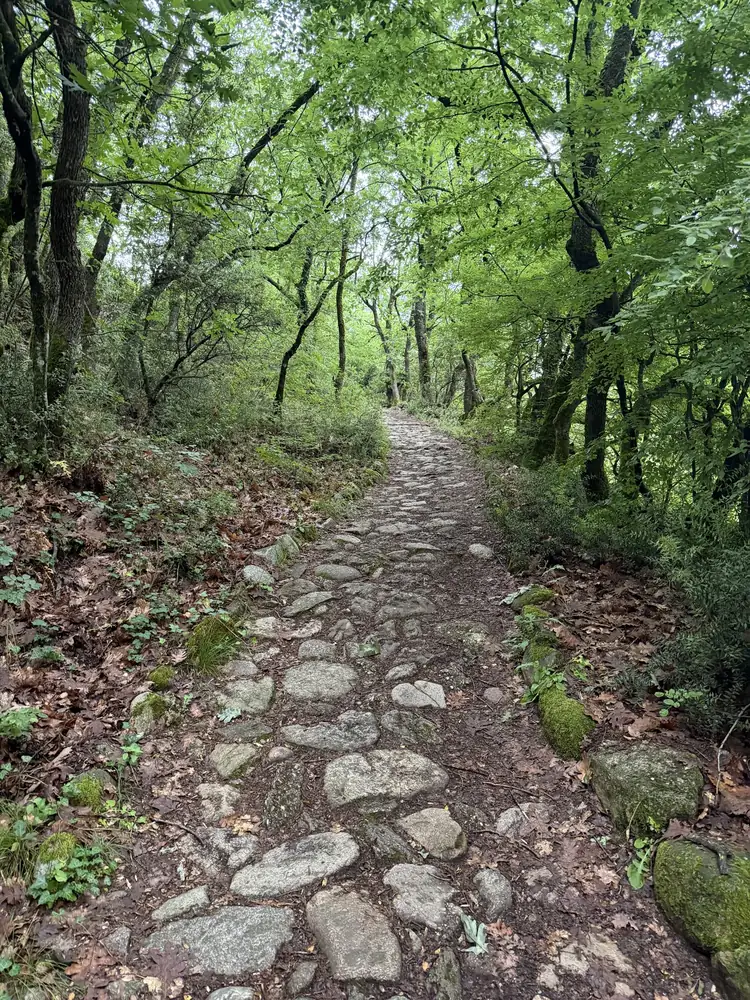
A centuries-old cobbled footpath through the oak woods below the rocks

03 · The terrain

Stone steps
and moderate climbs.

These are not mountain routes. They are short, steep-in-places paths with a lot of character, and most people who walk regularly find them very manageable.

What underfoot looks like

Old cobbled paths and stone steps, some worn smooth, dirt tracks through oak woods, and stretches of road where a path meets it. The climbs are short and moderate. The descents, especially on stone steps after rain, are where you want good shoes and your attention.

Shade and sun

The woodland sections are shaded and cool. The rock and the approaches to the monasteries are open to the sun. Carry water on every walk, even the short ones.

04 · Visiting the monasteries

Working monasteries,
not museums.

Six monasteries are open to visitors: Great Meteoron, Varlaam, Rousanou, Agios Nikolaos Anapafsas, Holy Trinity and Agios Stefanos. Monks and nuns live in them, and the rules at the door are theirs.

Dress and conduct

  • Women wear a skirt below the knee, with shoulders covered
  • Men wear long trousers, with no sleeveless tops
  • Some monasteries lend wrap skirts at the entrance, but they can run out, so carry your own in a pack
  • Photography is often not allowed inside churches and chapels. Look for the signs, and keep your voice low

Days, hours and entry

  • Each monastery closes on one day of the week, and the day differs from one to the next
  • Hours are longer in the summer season, roughly April to October, and change for religious holidays
  • Entry is a small fee per monastery, usually paid in cash. On our retreat, monastery entry fees are included
  • Check the current schedule shortly before you go, because it does change

05 · When to walk

Early,
before the heat and the buses.

Spring and autumn bring mild walking weather here, and late May sits comfortably in that window.

Time of day

Start in the morning. The air is cool, the light reaches the towers early, and the paths are quiet. A morning walk up from Kastraki or Kalambaka can reach the monasteries as their doors open. By midday the open sections get warm and the car parks fill.

Afternoons are for resting, and evenings, when the light turns gold on the rock, are for a slow walk through the village.

Weather in late May

Mild days and cool mornings. Daytime highs typically run about 72 to 79°F (22 to 26°C), and early mornings on the trail can be about 50 to 55°F (10 to 13°C). Spring showers are common, and a wet stone step is slippery, so a light rain jacket earns its place in the pack.

Getting here

Kalambaka is about four to five hours north of Athens by road. The train from Athens takes about five hours with a change at Palaiofarsalos, and while that line is being restored Hellenic Train runs a connecting bus for the last leg. On our retreat, the ground transfer from Athens to Kastraki and back is included.

06 · What to bring

A small pack,
and the right shoes.

For the trail

  • Broken-in hiking shoes or stable trail runners
  • A small daypack and a reusable water bottle
  • Comfortable layers for cool mornings
  • A light rain jacket
  • A hat and sun protection for the open sections
  • Trekking poles, if you like them on steps

For the monasteries and the rest

  • A wrap skirt below the knee for women, long trousers for men, and something to cover your shoulders
  • Some euros in cash for entry fees, lunches and gratuities
  • A plug adapter for type C and F sockets at 230 volts
  • A journal, for the quiet in the afternoons
Two walkers on a monastery footpath in Meteora

07 · How the retreat walks

Walking as practice,
not as a race.

Our hiking and meditation retreat in Meteora runs May 18 to 24, 2027: six nights in eco premium suites in Kastraki, twelve guests, hosted by Rachel and Eric.

Each day starts with breath and stillness on the terrace as first light reaches the towers, then onto the monastery trails. Hikes run three to nine miles a day at a conversational pace, with stops whenever they are wanted. Some trails have stone steps and all have moderate climbs. If you can walk comfortably for three hours, you can do this.

Afternoons are yours, with nothing scheduled. Evenings bring movement, mantra and meditation, then a long dinner in the village. Guided hikes and monastery entry fees are included, along with the transfer from Athens, breakfast, trail snacks and dinner.

The retreat is from $3,179 per person. A $500 deposit holds your room and comes off your room price. It is not refundable, because your room comes off the list the moment you book. If we cancel the retreat, you get everything back. The balance is due 90 days before the retreat begins.

Before you go

Questions people ask first.

Can you hike to the Meteora monasteries?

Yes. Footpaths lead up to the monasteries from Kastraki and Kalambaka. Kastraki to Great Meteoron and Varlaam is about 2.1 km and takes around 45 minutes one way, and Kalambaka to Holy Trinity is about 1.1 km and around 40 minutes, without stops.

How hard are the Meteora trails?

Mostly moderate. Expect stone steps, short steady climbs, woodland tracks and a few exposed points on some routes. Good shoes matter more than fitness. If you can walk comfortably for three hours, you can do the walks on our retreat.

What is the dress code at the monasteries?

Women wear a skirt below the knee and men wear long trousers, with shoulders covered for everyone and no sleeveless tops. Some monasteries lend wrap skirts at the door, but they can run out, so carry your own.

Are all the monasteries open every day?

No. Each one closes on a different day of the week, and hours change with the season and for religious holidays. Check the current schedule before you plan a walk around a particular monastery.

Should I stay in Kastraki or Kalambaka?

Kalambaka has more shops and the train station. Kastraki is smaller and quieter and sits right against the rocks, with trailheads at its edge. Our retreat stays in Kastraki for that reason.

Do I need a guide?

Not to walk the main paths, but waymarking is patchy and junctions can be confusing, so take an offline map. On our retreat, every hike is guided, so the only thing you have to find is your breath.

The view from a rock overlook across the plain below Meteora

Walk up into the quiet.
Six days, twelve people.

Hiking and meditation in Meteora, May 18 to 24, 2027. From $3,179, with the transfer from Athens, guided hikes and monastery entry included. Hold your room with $500, or write to us first.

Stay Connected

Keep the practice moving,
even between visits.

Retreat announcements, teacher training updates, workshop invites, and practice inspiration, straight to your inbox. No noise. Just the good stuff.

The next retreat could be one you experience, or one you hear about after it fills.

Rachel and Eric write it. Not a marketing team, not a scheduler. Rachel has been formally teaching and studying for 28+ years and training teachers for 25+, and most of what goes out is whatever she is actually working through that month, plus first word on retreats and cohort openings before they are posted anywhere.

28+ Years Formal Teaching and Studying 300+ Teachers Trained WYF Certified School

One email at a time, from an address you can reply to.

This site is protected by reCAPTCHA and the Google Privacy Policy and Terms of Service apply.